
The Complete Guide to SEO for Law Firms in 2026

Key Points
- SEO for law firms in 2026 requires a layered approach: technical foundations, practice area content, local search optimisation, link authority, and AI visibility — each element reinforces the others.
- Legal content sits within Google’s Your Money Your Life (YMYL) category, meaning it faces tighter quality scrutiny than most other sectors; firms that publish expert-led, author-attributed content consistently outperform those relying on volume.
- Local SEO remains the highest-return channel for most UK solicitors. A fully optimised Google Business Profile, consistent NAP citations, and a structured approach to client reviews can generate enquiries from clients who never visit your website.
- AI Overviews now appear in a significant proportion of legal searches. Firms cited within them receive substantially higher-quality traffic than those relying on traditional organic rankings alone.
- SEO is a long-term investment. Firms that build topical authority through well-structured content, earn links from reputable legal sources, and maintain technical hygiene will compound their visibility over time in ways that paid advertising cannot replicate.
Why SEO for Law Firms Matters in 2026
When a potential client needs a solicitor, they search. They type “divorce lawyer near me” or “employment tribunal advice Bristol” or “what happens if I miss a debt repayment” into Google, and they call one of the first firms they see. That is SEO for law firms in practice: getting your firm in front of people at the precise moment they need legal help.
The market has grown more competitive and starting from scratch takes hard work. Paul and I have been working with law firms that have invested heavily in digital marketing and content for over a decade. AI-generated summaries now appear at the top of results pages for many legal queries, compressing the space available to organic listings. And Google has raised its quality standards significantly, particularly for legal content, which it classifies as Your Money Your Life material. The result is that the firms ranking well today have earned their positions through genuine authority, not technical tricks.
One of our clients, who specialises in immigration law, has a dedicated team of SEO specialists and has been publishing two, carefully planned, keyword optimised articles every week for the past eight years. They are at the top of any Google search related to UK immigration law because they have earned that position through regular, strategic content marketing over many years.
This guide covers everything a UK law firm needs to understand about SEO in 2026: how it works, what the key components are, and how to build a strategy that generates real enquiries. Whether you are managing your own marketing or evaluating external support, the principles here will give you a clear picture of what good looks like.
Technical SEO: Getting the Foundations Right
Technical SEO is not the most exciting part of a law firm marketing strategy, but it is the most consequential. A website that search engines cannot properly crawl and index will not rank, regardless of how good the content is. Before anything else, these foundations need to be in place.
Site Speed and Core Web Vitals
Google uses Core Web Vitals, a set of metrics measuring loading speed, interactivity, and visual stability, as ranking signals. Pages loading in under three seconds consistently correlate with higher rankings and lower bounce rates. For law firms, slow-loading websites lose potential clients before the content is even read. Image compression, efficient code, and a reliable hosting provider are the starting points.
Mobile Responsiveness
Mobile browsing accounts for the majority of searches in the UK. Google uses a mobile-first index, meaning it primarily assesses the mobile version of your site for ranking purposes. A website that functions well on desktop but delivers a poor mobile experience will underperform in search results and lose clients who are searching on their phones.
Schema Markup
Structured data markup helps search engines and AI platforms understand what your website is about. For law firms, the most important schema types are:
- LegalService: specifies your practice areas and services. Note that the Attorney schema type is now deprecated.
- LocalBusiness: provides location and contact information for local search display.
- FAQPage: enables FAQ-style rich results and increases the likelihood of being cited in AI Overviews.
- Person: attributes content to individual solicitors, supporting E-E-A-T signals.
- Review: displays star ratings in search results.
Schema adoption remains low among UK law firms. Implementing it correctly represents a meaningful competitive advantage, particularly as AI search platforms rely heavily on structured data to parse and cite content.
HTTPS, URL Structure, and Site Architecture
HTTPS is non-negotiable. Google flags non-secure sites explicitly, and clients are unlikely to trust an unsecured legal website with their contact details. URL structures should be clean and logical: /practice-areas/family-law/ is better than /page?id=47. For firms with multiple practice areas, a hub-and-spoke architecture works well — a broad practice area page links to detailed sub-topic pages, distributing ranking authority across the site and improving internal linking.
Keyword Research and Search Intent
SEO for solicitors starts with understanding how clients actually search. Most people seeking legal help do not use formal legal terminology. They search for what they need in plain language: “how to challenge a will”, “can my employer dismiss me for being ill”, “how long does a house sale take.” Effective keyword research maps those real searches to the pages on your website.
Types of Keywords for Law Firms
The most valuable keywords for a law firm fall into three broad categories:
- High-intent local keywords: “employment solicitor Manchester”, “conveyancing lawyer Bristol”, “immigration solicitor near me.” These are the searches made by people ready to instruct. Competition is high but conversion rates are strong.
- Long-tail informational keywords: “what is a settlement agreement at work”, “how do I apply for a child arrangement order”, “what does a no-win no-fee solicitor charge.” These attract clients earlier in their decision process and build topical authority.
- Practice area support keywords: questions and guides related to your areas of law that bring in research traffic and demonstrate expertise.
Search Intent Mapping
Every page on your website should be built around a specific search intent. A page targeting “divorce solicitor London” should be an authoritative service page with clear contact options. A page targeting “how long does a divorce take in the UK” should be a detailed, informative guide. Mixing the two on a single page often serves neither purpose well. Mapping intent before writing content prevents this.
Keyword tools such as Google Search Console (free), Ahrefs, and Semrush can surface the terms driving traffic to competitors and identify gaps your firm could fill. Google’s People Also Ask feature and search autocomplete are useful for surfacing the exact language clients use.
On-Page SEO for Law Firm Websites
Once you know which keywords to target, on-page optimisation ensures each page signals its relevance clearly to search engines.
Title Tags and Meta Descriptions
Title tags are the single most important on-page ranking signal. Each page should have a unique title tag that includes the primary keyword and, where relevant, a location. “Family Law Solicitors in Leeds | Smith & Co” performs better than “Services | Smith & Co.” Meta descriptions do not directly influence rankings but affect click-through rates: a clear, specific description of what the page offers will attract more clicks than a generic one.
Header Structure
Headers (H1, H2, H3) organise your content and signal its structure to search engines. Each page should have one H1 — typically the page title or a close variant of the primary keyword — followed by H2 subheadings that break the content into logical sections. Avoid subheading formats like “Employment Law: What is Unfair Dismissal?”: the colon structure reads awkwardly and fragments the SEO value. Keep subheadings short and descriptive.
Internal Linking
Internal links connect pages across your site, distributing ranking authority and helping search engines understand your content hierarchy. A blog post on settlement agreements should link to your employment law service page. Your employment law service page should link to related blog posts and your contact page. A deliberate internal linking strategy — rather than ad hoc links added at publication — improves the ranking performance of every page on the site.
Practice Area Pages
Each practice area your firm handles deserves a dedicated, detailed page. Thin pages that list a practice area in a few sentences do not perform. Google expects substantive content that demonstrates genuine knowledge of the subject: what the law says, what clients typically need, what the process involves, and how your firm approaches it. These pages are also where SRA transparency requirements apply; fees information and service descriptions must comply with the Solicitors Regulation Authority’s standards.
Content SEO and E-E-A-T for Legal Websites
Google’s E-E-A-T framework — Experience, Expertise, Authoritativeness, and Trustworthiness — carries particular weight for legal content. Legal information can directly affect a person’s health, finances, or safety. Google holds it to higher standards than almost any other category, and the algorithm updates of 2025 enforced this rigorously.
What E-E-A-T Means in Practice
Experience refers to first-hand involvement. A guide to employment tribunal procedures written by a solicitor who has handled hundreds of such cases carries more weight than a generic overview. Expertise requires visible credentials: author bylines, professional qualifications, and links to solicitor profiles. Authoritativeness comes from external validation — links from legal directories, citations in reputable publications, and a consistent presence in your practice areas. Trustworthiness encompasses everything from HTTPS security to accurate information, clear contact details, and transparent fee information.
Firms that invested heavily in AI-generated content during 2023 and 2024 discovered this in 2025. Google’s core updates specifically targeted low-value, interchangeable legal content, and some websites lost substantial organic visibility as a result. The recovery path is straightforward but time-consuming: replace or substantially rewrite that content with material that demonstrates genuine expertise.
In my experience, this is where legally qualified digital marketing specialists make a substantial difference. Solicitors are too busy to spend time adding in the personal anecdotes and case studies now required to rank at the top of a Google search for particular terms. Someone who is qualified in law and experienced in legal practice can add this type of valuable insight with little guidance from fee earners.
Writing Legal Content That Ranks
Good legal content for SEO answers a specific question thoroughly, in plain language, and with evident professional knowledge. It does not need to be long for its own sake, but it needs to cover the topic properly. A 2,000-word guide that addresses every dimension of a question will outperform a 500-word summary that skims the surface. Structure matters: clear headings, logical progression, and a FAQ section at the end help both readers and search engines extract value from the page.
Author Attribution and Content Freshness
Every substantial piece of legal content should carry a named author with visible credentials. A “last reviewed” date signals to Google that the content is actively maintained. Law changes, and content that accurately reflected the legal position in 2022 may be misleading by 2026. A schedule for reviewing and updating existing content is as important as a plan for creating new material.
Local SEO for Solicitors
For most UK law firms — particularly those with one or two offices serving a defined geographic area — local SEO is where the most direct return on investment lies. Clients searching “solicitor near me” or “family lawyer in [town]” are expressing immediate intent. Ranking in the local pack for these searches puts your firm in front of people who are ready to call.
Google Business Profile
Your Google Business Profile is one of the highest-return marketing assets a firm can maintain. It requires consistent attention rather than a one-time setup. Key elements include:
- Accurate name, address, and phone number matching your website and all other listings exactly.
- Primary category set to “Solicitor” or “Law Firm” — the choice matters for visibility in practice-area searches.
- Secondary categories reflecting your practice areas (Family Law, Conveyancing, Employment Law, etc.).
- A keyword-rich business description (up to 750 characters) that includes your SRA number.
- Regular posts with updates, legal guides, or service information.
- Photos of your offices, team, and reception area.
- Active responses to every review, both positive and critical.
NAP Consistency and Legal Directories
Your firm’s name, address, and phone number should be identical across every online listing. Inconsistencies between your website, Google Business Profile, and directory listings create confusion for search engines and can suppress local rankings. The most valuable directories for UK solicitors include the Law Society’s Find a Solicitor, ReviewSolicitors, Trustpilot, Legal 500, Chambers and Partners, Yell, and Bing Places. Each entry builds a citation signal that reinforces your local authority.
Location-Specific Pages
Firms serving multiple locations benefit from dedicated pages for each area: “Conveyancing Solicitors in Chester”, “Employment Law Advice in Wrexham.” These must be substantive pages with genuinely local content — references to local courts, local case experience, and locally relevant information — rather than thin duplicates with the location name swapped in. Search engines and potential clients can tell the difference.
Client Reviews
Review signals carry significant weight in local pack rankings. A structured process for requesting reviews after successful matters, combined with professional responses to all feedback, builds a review profile that supports both rankings and client confidence. The SRA Code of Conduct applies: reviews cannot be incentivised, and responses must be measured and accurate. On that basis, the most effective approach is simply to ask satisfied clients directly, at the point when the matter concludes positively.
Link Building for Law Firms
Backlinks from trusted external websites signal to search engines that your firm is an authoritative source. For legal websites, the emphasis should be on quality over volume. A link from the Law Society or Legal 500 carries far more weight than dozens of links from low-quality directories.
Where to Build Links
The most reliable sources of high-quality backlinks for UK law firms are:
- Legal directories: the Law Society’s Find a Solicitor, Chambers and Partners, Legal 500, ReviewSolicitors, and the Solicitors Regulation Authority register all provide authoritative backlinks.
- Local directories and business listings: Bing Places, Apple Business Connect, and local chamber of commerce listings.
- Digital PR: getting your solicitors quoted as experts in local and national media generates backlinks from news sites with strong domain authority.
- Guest content: well-placed articles in legal publications, business journals, or sector-specific websites can earn quality links while demonstrating expertise.
- Professional associations and regulatory bodies: SRA registration, Lexcel accreditation pages, and Law Society practice area panels.
Avoid link schemes, paid link placements from irrelevant websites, and networks of low-quality blog posts. These tactics violate Google’s guidelines and risk manual penalties that can take months to recover from.
AI Search and Law Firm Visibility in 2026
AI Overviews now appear in a significant proportion of Google searches, including many legal queries. When a prospective client asks “do I need a solicitor for a boundary dispute,” they may see an AI-generated summary at the top of the results page before any traditional organic listing. The firms cited in that summary receive substantially higher-quality traffic than those ranked beneath it.
The data is clear. Firms cited within AI Overviews for legal queries experience higher click-through rates, lower bounce rates, and more time on site than firms relying on standard organic rankings. The audience is different: someone who has seen your firm cited as a source by Google’s AI already has a reason to trust you before they arrive.
Optimising for AI Visibility
Generative Engine Optimisation (GEO) builds on good SEO practice but adds specific requirements. Content should lead with clear, direct answers to common legal questions, structured so that AI tools can extract and cite them. The following adjustments improve a firm’s chances of appearing in AI-generated results:
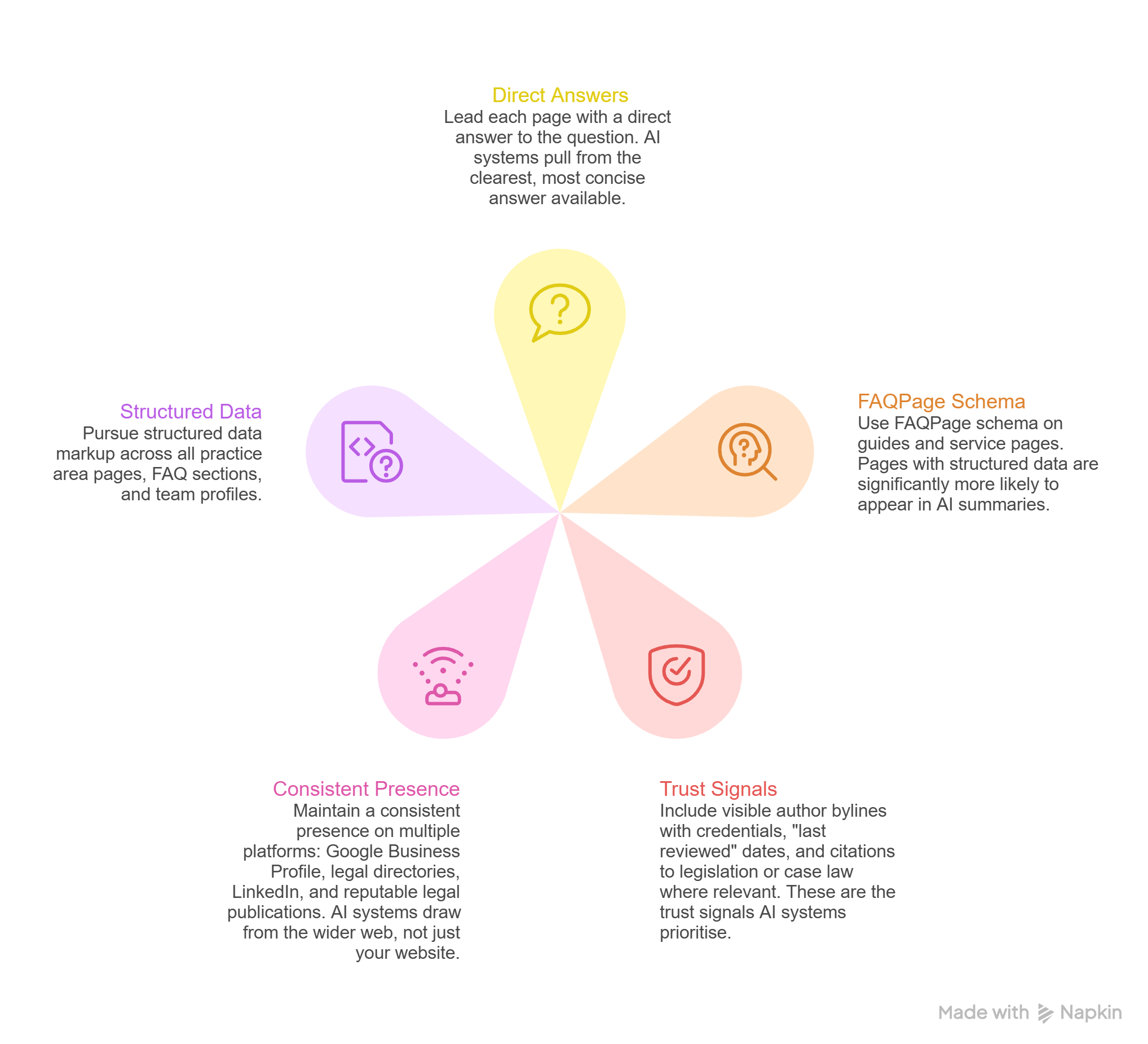
Search engines like ChatGPT and Perplexity are also increasingly used to find solicitors. The same principles apply: authoritative, well-structured, clearly attributed content is more likely to be cited across all AI platforms, not just Google.
Measuring SEO Performance
SEO investment should generate measurable returns. The metrics that matter for law firms are not likes or impressions — they are enquiries, conversion rates, and instructions generated. These are the numbers that connect marketing activity to business outcomes.
The most useful tools for tracking law firm SEO performance are Google Search Console (keyword rankings, click-through rates, indexing coverage), Google Analytics (traffic by channel, on-site behaviour, goal completions), and your Google Business Profile insights (calls, directions, website visits from local search). Combining these three gives a reasonably complete picture of organic and local search performance without significant cost.
Key Metrics to Track
- Enquiries by channel: how many new client enquiries came through organic search each month.
- Keyword rankings: movement in target keyword positions over time.
- Organic traffic: total visits from search engines and how that number trends.
- Local pack visibility: impressions, calls, and direction requests from your Google Business Profile.
- Core Web Vitals scores: technical health indicators accessible through Google Search Console.
- AI visibility: sessions arriving from AI-related referrers and observed citations in AI Overviews.
SEO results accumulate over time rather than arriving immediately. A realistic timeline for a new or recently optimised site is three to six months before meaningful ranking movement, with stronger results developing over twelve to eighteen months. Firms expecting overnight results from SEO investment are likely to be disappointed. Firms that treat it as an ongoing programme, reviewed and refined quarterly, consistently outperform those that treat it as a project with an end date.
Agency, In-House, or DIY?
Not every law firm needs an agency. Small firms with limited marketing budgets can make meaningful progress on local SEO independently, particularly on Google Business Profile management, citation building, and review generation. The technical and content elements of a comprehensive SEO strategy require more specialised knowledge, and the time investment is significant.
When evaluating an SEO agency for law firm work, ask whether their team includes people with actual legal knowledge. General marketing agencies can execute technical SEO competently, but legal content written without professional legal understanding often fails E-E-A-T standards and risks being inaccurate. At Lawtelligence, every piece of content we produce is written by LLB-qualified specialists. That distinction matters for both rankings and compliance.
Find out how we approach law firm SEO: Visit our Law Firm SEO service page
Your Law Firm SEO Checklist
The following checklist covers the most important actions for a UK law firm building or improving its SEO in 2026. Use it as a diagnostic tool or a starting point for your strategy.
Technical Foundations
- Site loading speed passes Core Web Vitals assessment (test via Google PageSpeed Insights).
- Website is mobile-responsive and tested on multiple devices.
- HTTPS configured with a valid SSL certificate.
- XML sitemap submitted to Google Search Console.
- LegalService, LocalBusiness, FAQPage, and Person schema implemented across relevant pages.
- No broken links or 404 errors (check monthly).
- Clean URL structure with logical hierarchy.
Keyword and On-Page
- Keyword research completed for all practice areas, including long-tail and local variants.
- Each practice area has a dedicated, substantive page targeting specific keywords.
- Each page has a unique title tag and meta description.
- H1 contains the primary keyword; H2/H3 structure is logical and consistent.
- Internal linking connects related pages across the site.
- Images have descriptive alt text.
Content and E-E-A-T
- Every article and guide carries a named author with visible credentials.
- Content is regularly reviewed and updated; “last reviewed” dates are displayed.
- Legal content cites relevant legislation and case law where appropriate.
- FAQ sections are included on major service and guide pages.
- No content produced purely by AI without substantive human review and revision.
- Solicitor profile pages include qualifications, experience, and areas of expertise.
Local SEO
- Google Business Profile fully completed with accurate NAP, categories, photos, and services.
- SRA number included in the GBP business description.
- NAP consistent across all directories and the firm’s website.
- Firm listed on: Law Society, ReviewSolicitors, Trustpilot, Legal 500, Bing Places, Apple Business Connect.
- Review generation process in place; all reviews responded to professionally.
- Location-specific pages created for each office or service area.
Link Building
- All major legal directory profiles complete and active.
- Digital PR strategy in place to earn media citations and backlinks.
- No participation in link schemes or paid link placements.
AI Search Optimisation
- FAQPage schema implemented on key pages.
- Content leads with direct, concise answers to target questions.
- Structured data covers LegalService, Person, and FAQ schema as a minimum.
- Firm visible across Google Business Profile, legal directories, and LinkedIn.
- Firm searched periodically in ChatGPT and Perplexity to assess AI visibility.
Download the full Law Firm SEO Checklist as a PDF: lawtelligence.co.uk/law-firm-seo-checklist
Frequently Asked Questions
How long does SEO take to work for a law firm?
SEO results build over time. Most firms see meaningful keyword movement within three to six months of consistent work, with stronger results developing over twelve to eighteen months. The timeline depends on the age and current authority of the website, the competitiveness of the target keywords, and the quality of the work being done. Local SEO, particularly Google Business Profile optimisation, often produces faster results than organic ranking improvements.
What is the difference between SEO for law firms and general SEO?
Legal SEO operates under more demanding quality standards than most other sectors. Google classifies legal content as Your Money Your Life material, meaning it applies tighter scrutiny through the E-E-A-T framework. Content must demonstrate genuine professional expertise, carry clear author attribution, and comply with SRA advertising requirements. General SEO tactics — bulk content production, aggressive link acquisition, keyword stuffing — tend to underperform or actively harm legal websites. The technical and local SEO principles are similar across industries, but content strategy must be adapted specifically for law.
Do small law firms need SEO?
Yes, and small firms often have a meaningful advantage in local search. Large national firms compete for broad, high-volume keywords but struggle to dominate hyper-local searches in specific towns and cities. A well-optimised small firm with a strong Google Business Profile, consistent local citations, and authoritative practice area content can outrank national competitors for the searches that matter most — clients in their immediate area ready to instruct. The investment required is proportionate to the size of the firm.
Should a law firm use Google Ads alongside SEO?
The two channels serve different purposes. SEO builds sustained organic visibility that delivers traffic without ongoing cost per click. Google Ads provides immediate visibility for competitive terms while organic rankings develop. For most small to mid-sized firms, the most practical approach is to use PPC selectively for high-intent, high-value practice areas where organic rankings are still developing, while investing consistently in SEO as the long-term foundation. Neither channel replaces the other.
How important are Google reviews for law firm SEO?
Client reviews directly influence both local pack rankings and conversion rates. Google’s local search algorithm gives significant weight to review signals: the number of reviews, the average rating, the recency of reviews, and the presence of owner responses all factor into local rankings. Beyond rankings, prospective clients rely heavily on reviews when choosing a solicitor. A structured, SRA-compliant process for requesting reviews after successful matters — combined with professional responses to all feedback — is one of the simplest and most effective SEO investments a firm can make.
Ready to Improve Your Law Firm’s Search Visibility?
Lawtelligence is an LLB-qualified legal marketing agency working exclusively with UK law firms. Our SEO strategies are built around genuine legal knowledge, SRA compliance, and measurable outcomes. We do not produce generic content or apply generic tactics to legal websites.
Find out more about our law firm SEO services or book a free strategy session by filling in our contact form or calling us on 01691 839661.
Author – Corinne McKenna
Corinne McKenna is the co-founder and director of Lawtelligence, a specialist legal marketing agency serving UK solicitors and barristers. With an LLB degree from the University of Canterbury and over 25 years’ experience in legal services sales and marketing, Corinne brings substantive legal knowledge to marketing strategy and brand development. Her background includes roles at LexisNexis in the UK and New Zealand, where she managed key legal accounts and delivered training to law firms. Corinne has authored widely on legal marketing topics for publications including Today’s Conveyancer and Solicitors Journal, with particular expertise in E-E-A-T principles, AI-optimised content, and SEO strategy for legal services.