
What’s The Difference Between SEO, AEO, AIO, and GEO?
Article Summary:
- Search has fractured. Law firms once competed for blue links on Google. Now they compete across answer engines, AI chatbots, voice assistants, and generative search platforms.
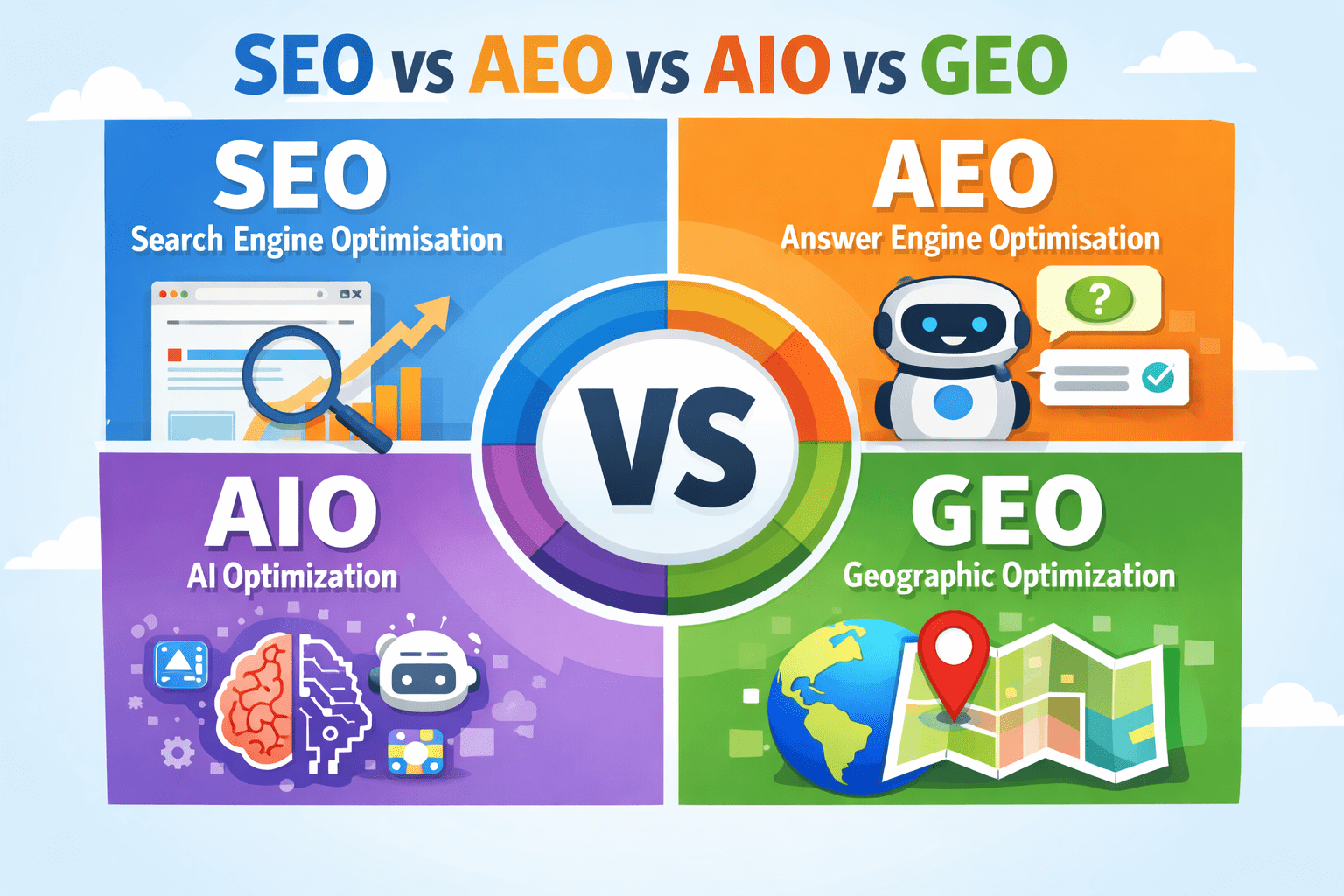
- Four strategies define visibility in 2026: SEO builds the foundation by securing organic rankings and ensuring content gets indexed.
- AEO captures featured snippets and voice search results where answers appear without clicks.
- AIO ensures AI systems trust and understand your content through structure, clarity, and authority signals.
- GEO positions your firm as a source AI tools cite when generating legal responses. Mastering all four determines whether potential clients find you or never know you exist.
Understanding the difference between SEO, AEO, AIO, and GEO is now a non-negotiable A potential client researching financial settlements in divorce no longer just types into Google and scrolls through ten blue links. They ask Siri while driving. They query ChatGPT for a summary of their options. They see Google’s AI Overview before they see your website. They consult Perplexity for cited sources.
Each platform uses different signals to decide which law firms appear. Traditional SEO rankings matter less when the answer appears directly on the search results page, never requiring a click. Voice assistants read one result aloud, not ten. AI chatbots synthesise information from multiple sources and generate original responses, citing only the firms they deem authoritative.
The law firms that dominate visibility in 2026 treat search as an ecosystem, not a single channel. We advise our clients to build content that satisfies search engines, answer engines, and generative AI platforms simultaneously. This is because we have seen that firms that focus solely on traditional rankings are seeing their traffic evaporate as users find answers elsewhere.
SEO Remains the Foundation
Search Engine Optimisation ensures Google, Bing, and other search engines rank your pages for relevant legal queries. Without solid SEO, nothing else functions.
For solicitors, SEO means your site appears when potential clients search for terms connected to your practice areas. Your content gets indexed, crawled, and trusted by search engines. Your pages load quickly, work on mobile devices, and feature clear internal links between related legal topics.
SEO success translates to keyword rankings, click-through rates from search results, and organic traffic to your site. A family law firm ranking in the top five positions for “financial settlement divorce” captures high-intent traffic. A firm buried on page three never gets the opportunity.
Technical health matters. Search engines penalise slow sites, broken links, and mobile-unfriendly pages. They reward clean site architecture, fast load times, and secure HTTPS connections. Law firms that neglect technical SEO lose visibility regardless of content quality.
Building authoritative pages requires depth. Thin content triggers spam filters. Thorough guides demonstrating mastery of practice areas earn rankings. A 300-word post about consent orders competes poorly against a 2,000-word guide explaining how consent orders work, when they apply, what courts require, and how they interact with financial settlements.
Authority also requires backlinks. Links from reputable legal directories, bar associations, and referral sources signal credibility. A mention in The Law Society Gazette carries more weight than 100 low-quality directory listings. Firms that earn editorial backlinks from trusted legal publications build domain authority that compounds over time.
AEO Captures Direct Answers
Answer Engine Optimisation targets a different outcome. Instead of ranking in position one, AEO wins the featured snippet, the voice search result, or the People Also Ask box.
When someone asks Siri, “What is a financial settlement in divorce?”, the answer comes from a single source, read aloud without attribution beyond the website name. If your firm’s content gets selected, you win the query without the user needing to visit your site. You become the authority by default.
Featured snippets appear at the top of Google search results in a boxed format. They answer questions directly, pulling content from a single page. Winning the snippet means your content appeared clearer, more concise, and better structured than competing pages. Google’s algorithm selected you because your answer matched the user’s needs.
People Also Ask boxes expand when clicked, revealing additional questions and answers. Each answer cites a different source. Law firms that structure content around common client questions appear repeatedly in these boxes, dominating visibility for related queries.
Voice search prioritises local intent. Queries like “divorce lawyer near me” signal urgency and high conversion potential. Voice assistants favour concise answers from sources with strong local SEO signals. NAP consistency across directories, active Google Business Profiles, and location-specific content improve voice search performance.
Structured data helps. FAQ schema markup tells Google which parts of your content answer specific questions, increasing eligibility for featured snippets. A properly marked-up FAQ section is more likely to be selected than unmarked content, even if the quality matches.
AEO requires intentional formatting. Write direct answers of 40 to 60 words following question-based subheadings. Use plain English definitions in opening paragraphs. Avoid legal jargon unless necessary, then define it immediately. Structure content so each section stands alone, answering one question completely before moving to the next.
AIO Ensures AI Systems Understand You
AI Optimisation goes beyond winning snippets. It makes your entire content ecosystem clear, trustworthy, and usable by artificial intelligence systems.
Semantic clarity matters. AI models understand meaning, not just keywords. Explaining how “financial settlement,” “asset division,” and “consent order” relate to each other helps AI systems map your expertise. Isolated definitions provide less value than connected explanations showing how concepts interact.
Structured data allows AI to parse your content accurately. Schema markup for FAQPage, Article, LocalBusiness, and LegalService tells machines what your content represents. A page without schema forces AI to guess. A page with proper schema removes ambiguity, increasing the likelihood AI systems cite it confidently.
E-E-A-T signals prove trustworthiness. Google’s algorithms and human reviewers evaluate Experience, Expertise, Authoritativeness, and Trustworthiness. Legal content falls under Your Money or Your Life guidelines, meaning stricter quality standards apply. Weak E-E-A-T signals harm legal websites more severely than they harm lifestyle blogs.
- Experience is demonstrated through case examples, specific outcomes, and practice insights that illustrate real-world work. Generic explanations signal a lack of direct experience. Specific examples of anonymised client situations demonstrate that you handle these matters regularly.
- Expertise requires visible credentials. Author bios listing years in practice and relevant qualifications reinforce authority. A blog post without attribution carries less weight than one written by a named solicitor with credentials displayed prominently.
- Authoritativeness comes from external validation. Backlinks from the SRA, Law Society, media mentions, and citations from other legal professionals signal that peers recognise your expertise. Social proof through reviews, testimonials, and professional memberships strengthens this signal.
- Trustworthiness requires transparency. Display last-updated dates on content to signal freshness. Cite relevant case law and legislation to show accuracy. Link to authoritative sources like legislation.gov.uk to demonstrate that you base advice on proper legal foundations, not assumptions.
Content depth demonstrates mastery. AI systems evaluate whether you covered expected subtopics, answered likely follow-up questions, and provided specific examples. Thorough guides of 1,500 to 2,500 words signal expertise more effectively than thin posts of 300 words.
GEO Gets AI Systems to Cite You
Generative Engine Optimisation positions your firm as a source that ChatGPT, Perplexity, Google’s Gemini, and similar AI tools cite when generating legal answers.
These systems don’t rank pages. They synthesise information from multiple sources and generate responses. If your firm’s content gets cited in that AI-generated answer, you gain brand visibility and source attribution without the user clicking through to your site.
Authority determines selection. AI systems prioritise sources they perceive as trustworthy and expert. They evaluate backlink profiles, reviews, social proof, and brand recognition to assess credibility before citing a source.
Your entire digital presence counts. Mentions in legal directories, referral networks, and media outlets signal legitimacy. An active Google Business Profile with positive reviews reinforces local authority. Consistent NAP information across all online directories tells AI systems your firm exists and operates where you claim.
Original research and insights attract citations. Anonymised case studies, statistical analyses, and legal commentary demonstrate thought leadership. AI systems cite sources that explain the “why” and “how” behind legal concepts, not just definitions.
Building relationships with legal journalists and bloggers increases citation opportunities. Media mentions create backlinks and simultaneously build brand awareness. Participating in industry networks like Resolution or The Law Society positions you within the professional community, increasing the likelihood that your name will appear in AI training data.
Unlike traditional SEO, you can’t yet directly track GEO performance. Tools like AthenaHQ and Peec AI track AI citations, but they remain early-stage. Manual monitoring works. Search your target keywords in ChatGPT, Perplexity, and Google’s AI Mode, then note whether your firm appears in responses.
How the Four Strategies Work Together
SEO, AEO, AIO, and GEO don’t compete. They layer.
SEO gets your content indexed and ranked. Without it, search engines never find your pages. AEO restructures your best-ranking content to win featured snippets and voice search results. AIO ensures AI systems trust and understand your content enough to cite it. GEO positions your firm as a preferred source AI tools reference when generating answers.
A family law firm targeting “financial settlement divorce” builds visibility through all four strategies simultaneously. SEO secures rankings in positions one to five for the target keyword and related long-tail variations. AEO wins the featured snippet when someone asks, “What is a financial settlement in divorce?” AIO ensures clear structure, proper schema markup, and E-E-A-T signals so ChatGPT and Perplexity recognise the content as authoritative. GEO earns citations when AI systems answer financial settlement questions, positioning the firm as a trusted source.
One well-structured piece of content serves all four strategies. A thorough 2,000-word guide on financial settlements can rank for SEO, answer AEO questions through a clear FAQ section, demonstrate AIO through proper markup and credentials, and provide GEO source material through depth and original insights.
Prioritise strategically. Build SEO first as the foundation. Add AIO elements to make content trusted and usable by AI. Incorporate AEO tactics to win answer boxes. Develop GEO authority through backlinks and thought leadership. Running all four in parallel delivers maximum visibility across search channels.
Practical Implementation
- Structure content intentionally. Use question-based H3 headings followed by concise answers of 40 to 60 words targeting featured snippets. Break dense legal text with subheadings and bullet points to improve scannability. Write 1,500 to 2,500-word guides instead of thin posts to signal depth and expertise.
- Add schema markup to every relevant page. Implement FAQPage schema for Q&A sections, Article schema for blog posts, LocalBusiness schema for contact pages, and LegalService schema for practice area pages. Validate markup using Google’s Rich Result Test and schema.org validators.
- Build E-E-A-T signals systematically. Ensure every author bio includes credentials and years of practice. Link to team profiles from content pages. Cite relevant case law and legislation to build authority. Display last-updated dates to signal freshness. Maintain consistent NAP information across all directories.
- Earn high-quality backlinks from reputable legal directories, bar associations, and media outlets. Avoid link farms and paid networks that damage credibility. Publish original research or case study insights to attract citations naturally. Partner with legal journalists through services like HARO to gain editorial mentions.
- Audit your existing citations. Use tools like Moz Local, BrightLocal, or Yext to identify NAP inconsistencies across directories. Prioritise fixing discrepancies on high-authority platforms like Google Business Profile, which have the greatest impact on local SEO.
- Monitor performance across channels. Track traditional rankings and traffic through Google Search Console and Google Analytics. Validate schema through Google’s Rich Result Test. Manually search target keywords in ChatGPT, Perplexity, and Google’s AI Mode to monitor citations.
The Competitive Advantage
Most law firms still focus solely on traditional SEO. Only 3% currently optimise for voice search. Few understand GEO or AIO. The firms that adopt all four strategies early dominate visibility before competitors recognise the shift.
Search has evolved beyond blue links. Potential clients find legal services through Google, voice assistants, AI chatbots, featured snippets, and generative AI platforms. Each channel requires different optimisation strategies. Firms that master SEO, AEO, AIO, and GEO together capture clients across all discovery methods.
The investment remains straightforward. Write better content with a clear structure. Add proper markup. Build genuine authority through reputable backlinks. Demonstrate E-E-A-T through credentials, citations, and transparency. These practices benefit algorithms and clients equally.
Search visibility in 2026 requires treating search as an ecosystem, not a single tactic. The law firms that adapt early gain market share. Those who delay will lose ground to competitors who already appear in AI responses, voice search results, and featured snippets.
FAQs
Do I still need SEO if I’m optimising for AEO and GEO?
Yes. SEO remains the foundation. Without strong traditional rankings, pages never become eligible for featured snippets or AI citations. SEO gets content indexed and positions pages so answer engines can find them and AI systems can evaluate them. AEO and GEO build on SEO, they don’t replace it.
What’s the difference between AEO and AIO?
AEO targets specific visibility wins, such as featured snippets, voice search results, and People Also Ask boxes. It focuses on concise, structured answers to direct questions. AIO covers broader strategies, making your entire content ecosystem clear, trustworthy, and usable by AI systems. AIO includes semantic clarity, entity relationships, E-E-A-T signals, and structured data. AEO wins individual answer boxes. AIO ensures AI systems understand and trust your entire firm.
How do I optimise for GEO if I can’t track AI citations?
Build traditional authority signals first. Earn backlinks from reputable legal directories and bar associations. Maintain an active Google Business Profile with positive reviews. Keep NAP information consistent across all directories. Join professional networks like Resolution or The Law Society. Publish original insights and case studies demonstrating expertise. Write content addressing the “why” and “how” behind legal concepts, not just definitions. Use schema markup so AI can accurately extract and attribute your information. Manual monitoring works. Search target keywords in ChatGPT, Perplexity, and Google’s AI Mode to check whether your firm appears in responses.
Can one piece of content serve SEO, AEO, AIO, and GEO?
Yes. A well-structured thorough guide serves all four if built correctly. Target your main keyword in the H1 and throughout the content for SEO. Include a clear FAQ section with question-based headings and concise answers for AEO. Add schema markup, E-E-A-T signals, and proper subheadings for AIO. Write with depth, original insights, and proper citations to serve as GEO source material. Treat content as a resource demonstrating expertise, not a quick post.
How long does it take to see results from SEO, AEO, AIO, and GEO?
SEO requires three to six months for initial rankings, six to twelve months for top positions. AEO can show results in two to four weeks for featured snippet eligibility once content goes live if well-structured, though consistent selection takes three to six months. AIO works continuously as AI systems crawl and update their understanding, but trust-building accelerates with consistent authoritative signals. GEO takes three to six months because AI systems need time to crawl and index content while accumulating third-party authority signals such as backlinks, reviews, and mentions. Treat all four as long-term investments.
Corinne McKenna is the co-founder and director of Lawtelligence, a specialist legal marketing agency serving UK solicitors and barristers. With an LLB degree from the University of Canterbury and over 25 years’ experience in legal services sales and marketing, Corinne brings substantive legal knowledge to marketing strategy and brand development. Her background includes roles at LexisNexis in the UK and New Zealand, where she managed key legal accounts and delivered training to law firms. Corinne has authored widely on legal marketing topics for publications including Today’s Conveyancer and Solicitors Journal, with particular expertise in E-E-A-T principles, AI-optimised content, and SEO strategy for legal services.