
Why AI Overviews Has Rewritten the Rules for SEO
Summary
- AI Overviews now appear in 60% of Google searches as of February 2026, fundamentally altering how potential clients discover legal services and driving a shift from click-based metrics to citation-based visibility.
- Law firms experienced a median 42% drop in search impressions following September 2025, when AI Overviews expanded aggressively into commercial and navigational queries affecting legal practice areas.
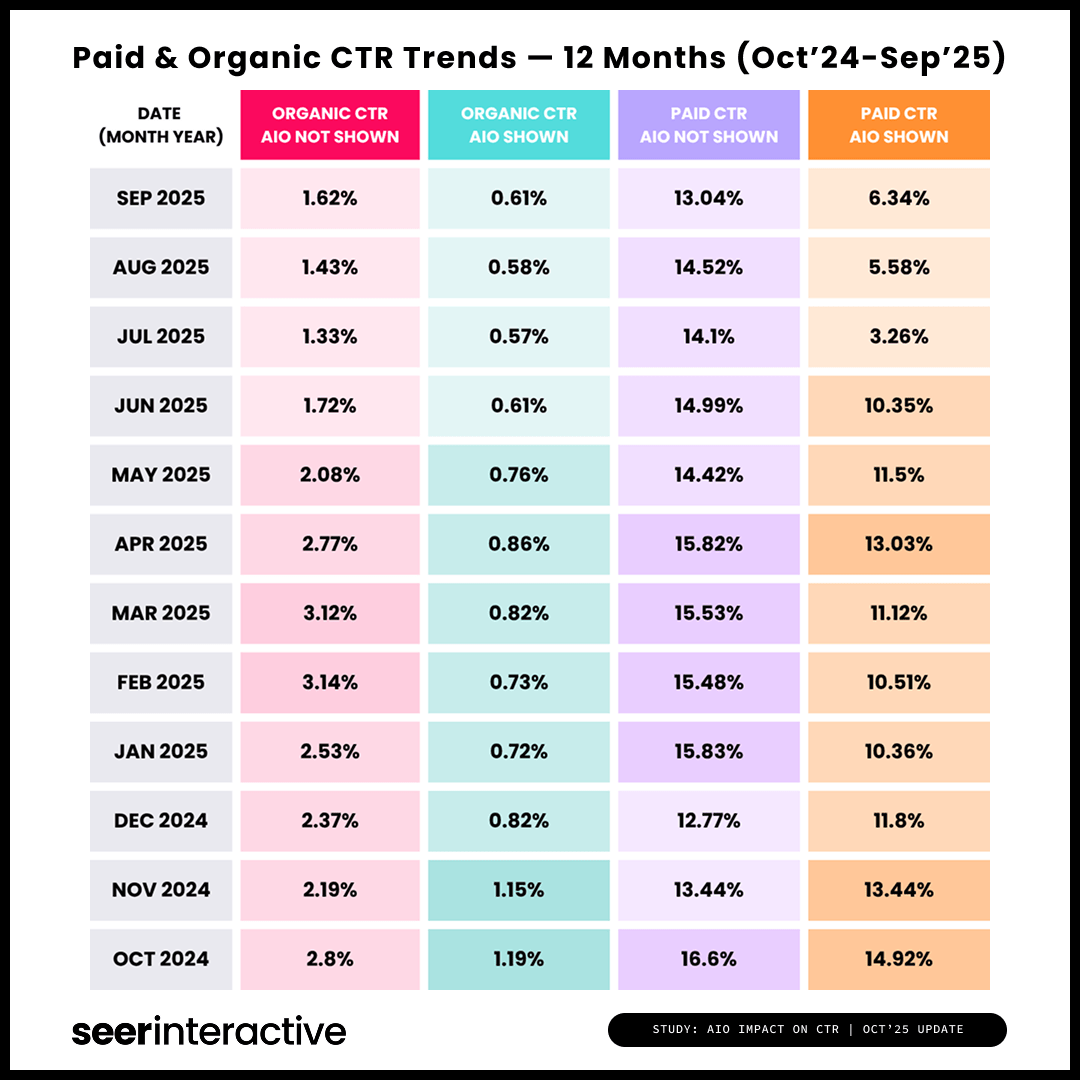
- The traditional click-through rate model has collapsed, with citations in AI-generated summaries now delivering higher-quality engagement than traditional rankings, producing 35% more organic clicks and 91% more paid clicks for firms mentioned in overviews.
- Law firms must pivot from optimising for search position to optimising for AI visibility, requiring restructured content, clearer answers, and consistent presence across multiple AI platforms including Google, ChatGPT, and Perplexity.
- Firms that adapted early by building answer-focused content and pursuing citations in AI systems report up to 527% year-over-year growth in AI-driven search traffic, whilst those relying on traditional SEO strategies have seen visibility collapse.
The law firm’s managing partner pulled up Google Analytics on a quiet Tuesday afternoon in September 2025. The numbers didn’t make sense. Overall traffic was down sharply, yet the quality of inquiries remained stable. Conversions had barely shifted. The metrics that had defined digital success for the past decade seemed suddenly irrelevant.
She had just witnessed something few were willing to name publicly: the collapse of the click-based search economy.
What happened that month wasn’t an algorithm update in the traditional sense. Google didn’t penalise certain sites or change how pages ranked within search results. Instead, the company quietly expanded AI Overviews from informational queries into commercial and navigational search, fundamentally transforming how millions of people sought legal guidance.
By February 2026, AI Overviews appear in six of every ten Google searches. For legal queries, the proportion runs even higher. The blue links remain on the page, technically visible, but they’ve been displaced by an artificial intelligence system that answers questions before anyone clicks through to a website.
This wasn’t supposed to happen. Or rather, it was supposed to happen slowly.
The Invisible Apocalypse
The first sign of trouble appeared in quarterly reporting. A study of eighteen UK law firms found a median 42% drop in search impressions following September 2025. Not a dip. A disappearance. The firms weren’t penalised or removed from rankings. Their pages simply became less relevant in a search environment that had fundamentally changed.
The shift cut across firm size and practice area. Personal injury firms saw their traffic for common queries evaporate. Employment law practices found that users seeking tribunal guidance were receiving AI-synthesised answers without ever visiting a website. Conveyancing firms discovered that property-related searches now generated immediate summaries, satisfying user intent directly within the search interface.
Yet something counterintuitive accompanied the traffic collapse. Firms that appeared in AI Overviews and were cited as sources in the synthesised summaries often saw their overall engagement increase. The traffic dropped, but the traffic that arrived proved more qualified, more intent-driven, more likely to convert.
This paradox confused firms clinging to traditional metrics. Lower traffic figures suggested loss. In fact, what had changed was the composition of that traffic. The high-volume, low-intent visitors who once clicked through to read general legal information had evaporated. The remaining traffic consisted of people ready to take action, typically those ready to hire a solicitor.
The Analytics reflected correction rather than collapse.
What Really Happened
The story begins with Google’s decision to expand AI Overviews beyond its initial scope. When the feature launched in 2024, it primarily affected informational queries, such as “What is a settlement agreement?” “How does a Family Court order work?” “What rights do I have in an unfair dismissal claim?”
For these questions, AI Overviews provided genuine value. Users received clear, concise answers drawn from multiple authoritative sources. They understood their situation better without having to click through multiple websites.
By September 2025, Google began expanding this approach into commercial and navigational territory. The algorithm started generating summaries for queries like “Employment solicitor Manchester”, “Settlement agreement template”, and “Tribunal representation near me”. These weren’t purely informational. These were queries from people actively seeking legal services.
The expansion triggered enormous disruption. A Semrush analysis of ten million keywords showed that whilst AI Overviews initially appeared on roughly 13% of searches in early 2025, they had reached 60% by December 2025. More significantly, the types of queries triggering AI Overviews had evolved. Commercial and navigational intent dominated the expansion, affecting exactly the searches that converted prospects into clients.
The timing matters. This expansion coincided with Google’s broader rollout of AI Mode in the United States. Previously available only to select users in Labs, AI Mode became the default for millions of people. Instead of viewing traditional search results with an AI summary at the top, these users engaged with a conversational interface where answers emerged through dialogue rather than a list.
For law firms accustomed to ranking for keywords, the shift felt apocalyptic. The visible universe of search results had shrunk. The top ten positions, which once delivered meaningful traffic, now compete for attention with synthesised answers that aggregate multiple sources into a single response.
The Quality of Invisibility
Here lies the counterintuitive discovery that separated firms that survived from those that were simply buried.
When a firm’s expertise, credentials, and clear answers qualified it for citation within an AI-generated summary, something unexpected occurred. The traffic it lost in click-through volume transformed into higher-value engagement. Users arriving from AI Overviews were primed with information they had already received, predisposed to trust sources they had encountered in the synthesis, and ready to move toward action.
The data confirmed this consistently across 2025 and into 2026. Firms cited within AI Overviews for legal queries experienced:
- Thirty-five per cent more organic clicks than firms not appearing in summaries
- Ninety-one per cent more paid search clicks from the same queries
- Twenty-three per cent lower bounce rates
- Forty-one per cent more time on site
- Twelve per cent more pages viewed per visit
These aren’t minor variations. These represent a fundamental restructuring of how legal visibility translates into business outcomes. A firm receiving 10,000 visitors from traditional rankings might see 250 contacts. A firm receiving 2,000 visitors from AI citations might see 600 contacts.
The mathematics no longer favour volume. They favour relevance.
For most firms, recognising this reality required abandoning years of accumulated strategy. The entire SEO industry, built on optimising for position one in search results, faced an existential recalibration. You could rank first for a query and still receive negligible traffic if an AI system answered the question beforehand.
How Firms Became Invisible
The mechanics of invisibility prove instructive. When Google’s systems generate an AI Overview, they select information from multiple authoritative and relevant sources. The selection process considers several factors.
- The content must answer the question clearly and directly. Vague, hedging language loses priority. Specific, actionable information rises. A firm publishing an article titled “What is an unfair dismissal claim?” that begins with three paragraphs of general context before addressing the actual question gets downranked in favour of content that answers immediately.
- The author must be verifiable and qualified. Anonymous content, generalist writers, and material without clear credentials disappear from consideration. AI systems are more rigorous than human readers in this assessment. They cross-reference claims against external sources, verify credentials through accessible databases, and flag inconsistencies. A solicitor’s name means nothing without corresponding verification that the solicitor is actually licensed and practices in the relevant area.
- The content must demonstrate genuine expertise through specificity. Firms publishing generic guidance (“Settlement agreements should cover pay, benefits, and references”) lose priority against those providing actionable detail (“Settlement agreements should explicitly state the notice period employers are waiving, the redundancy payment formula, and whether pension entitlements continue through any garden leave period”).
- The source domain must show consistent quality across all content. A firm publishing high-quality articles in one practice area but allowing outdated or generic content to accumulate elsewhere drags down its overall authority. Search systems increasingly evaluate entire sites holistically rather than piece-by-piece.
Firms that failed on these dimensions didn’t merely drop in rankings. They vanished from consideration entirely. AI systems simply didn’t reference them. Their content never appeared in summaries. Users never encountered them as sources.
The Pivot Required
The first and most fundamental change required firms to restructure their entire content marketing approach. The traditional blog post, designed to capture keyword traffic through volume and optimisation, became counterproductive. Publishing dozens of articles, hoping some would rank, no longer worked when only the highest-quality sources appeared in AI-generated summaries.
Leading firms shifted to producing fewer, deeper articles. Instead of publishing weekly, they began producing monthly. Instead of targeting multiple keyword variations, they focused on comprehensive answers to core questions in their practice areas.
Each article now starts differently. Rather than context-setting introductions, the content opened with direct answers. “A settlement agreement is a legally binding contract in which an employer and employee agree on the terms under which the employment relationship concludes.” This immediate clarity allows AI systems to extract useful information quickly. Lengthy preambles delay value delivery, making content less attractive for summarisation.
The articles incorporated specific, actionable details throughout. Generic statements about law gave way to procedural specificity. Rather than “employment tribunals consider multiple factors in determining unfairness”, high-performing content specified “the tribunal will examine whether the dismissal followed the ACAS Code of Practice three-step procedure, whether the dismissal was the only reasonable response to the conduct, and whether the employer applied the same standards to all employees.”
Every article included anonymised examples from actual cases. Not hypotheticals. Not textbook scenarios. Real situations the firm had handled. These examples demonstrated genuine experience in a way no amount of credential-listing could achieve. They showed the expertise in action.
Citations transformed dramatically. Generic references to “employment law” gave way to specific citations of relevant legislation, case law, and government guidance. A firm explaining tribunal procedure would link directly to the Employment Tribunals Act 1996, cite relevant Employment Appeal Tribunal decisions, and reference ACAS guidance documents. These citations accomplished two purposes: they helped readers verify information independently, and they signalled to AI systems that the content rested on reliable foundations.
Building Authority in an AI-First World
The second major change involved reconstructing author credentials for visibility in AI systems.
Law firms had long maintained author pages on their websites. Few users actually visited them. Potential clients typically didn’t care whether an article was written by a solicitor named James Morrison or someone called Sarah Chen. They cared about the quality of the information itself.
AI systems operate differently. They care intensely about authorship. The credential architecture now required becomes almost forensic in its detail.
Every solicitor publishing content needed a comprehensive profile. Name, photograph, bar admission details, including year and jurisdiction. Law school and graduation year. Undergraduate degree. Specialisation areas with years of experience in each. Publications, speaking engagements, and professional association memberships.
But profiles alone proved insufficient. The system needed verification against external sources. Direct links to Law Society profiles became essential. LinkedIn profiles that demonstrated the solicitor’s practice history gained importance. Published articles in professional publications, recordings of speaking engagements, and entries in legal directories. Each external reference point strengthened the verifiability of credentials.
The connection between author and content became explicit in new ways. Every article included not only the author’s name but also a mini-biography that established their specific expertise for that topic. An article on employment tribunal procedure would include “written by Sarah Chen, who has represented employees in over 200 tribunal hearings over the past eight years, focusing on unfair dismissal and discrimination claims.” This contextualisation helps AI systems understand why this particular person was qualified to address this particular question.
Firms that had allowed multiple people to publish without attribution, or that had used content from generalist writers, faced significant challenges. The remediation required either having qualified solicitors claim genuine authorship of existing articles (only if they could truly stand behind them) or removing the content entirely. The short-term traffic loss from deletion often proved less damaging than ongoing invisible penalties for unattributed content.
The Paid Search Recalibration
An organic traffic collapse didn’t necessarily mean an overall traffic collapse if firms simultaneously adapted their paid search strategy.
Traditional paid search involved bidding on keywords and paying when users clicked the ad. The model worked well when users were actively seeking information from websites. But when AI Overviews answer questions before anyone clicks, the value proposition shifts.
Forward-thinking firms adjusted by focusing paid search on high-intent keywords. Rather than bidding broadly on general terms like “employment solicitor”, they targeted specific phrases indicating near-decision intent: “settlement agreement review”, “unfair dismissal solicitor near me”, “employment tribunal representative [location]”. These queries, whilst lower volume, brought users substantially further along the decision journey.
They also adjusted bid strategies to prioritise impression share over click volume. A firm might accept lower click-through rates if it maintained strong visibility for important queries. The goal became ensuring that when someone searched for relevant terms, the firm appeared prominently, whether that meant in traditional ads or through repeated mentions in AI summaries.
Some firms experimented with direct integrations. They provided content to professional directories, ensuring the firm appeared in curated lists within AI summaries. They pursued partnerships with verified legal resources. They contributed expertise to trusted publications, increasing the likelihood of being cited as an authoritative source.
The paid search environment evolved as Google itself continued testing. By early 2026, the company had begun experimenting with sponsored content within AI Overviews, creating new paid opportunities specifically within the summary format. Early adopters found these placements drove substantial engagement.
The Platform Multiplication
The third major shift involved accepting that Google was no longer the only search destination requiring attention.
ChatGPT, Perplexity, and other AI platforms have grown substantially. By late 2025, ChatGPT was receiving approximately 2.5 billion queries daily. Not all of these were search-adjacent, but millions involved questions that legal consumers would previously have typed into Google.
“How do I challenge an unfair dismissal decision?” someone might ask ChatGPT rather than Google. “What does a settlement agreement typically contain?” “Can I claim constructive dismissal if my employer reduced my hours?” These questions don’t appear in Google search results in traditional metrics. Yet they’re being asked, answered, and the questioner is developing opinions about which law firms seem knowledgeable based on the sources the AI system references.
Law firms accustomed to focusing exclusively on Google’s algorithm discovered they needed to optimise for AI platforms they didn’t control and couldn’t rank in directly. The approach required different thinking. Rather than producing content specifically for Google’s algorithm, firms had to produce content that served underlying information needs well enough that multiple AI systems would naturally reference it.
This meant writing more comprehensively. ChatGPT and Perplexity pull from broader content sources than Google, and they handle training data differently. Content that ranked well in Google’s results often didn’t appear in other systems. The firms that adapted created substantial, authoritative resources around major topics, increasing the chances that multiple AI systems would reference them.
It also meant strategically pursuing presence across multiple platforms. Law firms began contributing to trusted legal platforms that were included in the training data for major AI systems. They pursued mentions in professional associations and directories. They built relationships with established legal publications. The goal shifted to ubiquity across trusted sources rather than dominance on a single platform.
The Metrics That Matter Now
The quarterly meeting where traffic metrics no longer made sense became commonplace throughout 2025 and into 2026.
Firms relying on traditional analytics found their dashboards increasingly misleading. Total website visitors declined. Click-through rates plummeted. But the most forward-thinking firms had begun tracking entirely different metrics.
Share of voice emerged as critical. For core legal queries within a practice area, how often did the firm appear in AI summaries compared to competitors? A firm tracking this metric could see whether it was gaining or losing visibility in the AI-first search environment, regardless of actual traffic numbers.
Citation frequency became trackable. How many times did AI systems reference the firm’s content when answering legal questions? Firms could monitor this through Google Search Console, observation of AI-generated summaries, and increasingly through purpose-built tools designed specifically for tracking AI visibility.
Visibility score replaced ranking position. Rather than asking “what position does the firm rank for this keyword?”, firms began asking “what proportion of AI-generated answers for this topic reference the firm?” This metric captured the reality of the new search environment far more accurately.
Inquiry quality became emphasised over inquiry volume. Not all inquiries convert equally. An inquiry from someone who encountered the firm in a traditional search result might be broadly interested. An inquiry from someone who encountered the firm through an AI summary typically had far greater intent. Firms began measuring cost per conversion rather than cost per click, revealing that lower traffic volumes often translated into substantially higher conversion rates.
One striking observation emerged across firms that closely monitored these metrics: the collapse in “vanity” traffic didn’t predict business decline. When the high-volume, low-value visitors disappeared, they were replaced by smaller volumes of higher-intent prospects. The impact on profitability was often minimal or positive, even as total traffic fell sharply.
Mistakes Still Being Made
As of early 2026, predictable errors continued plaguing firms attempting to adapt.
Some treated AI visibility as a new layer to add to existing strategies rather than a fundamental reorientation. They optimised content for Google’s algorithm, then created separate AI-focused content. This bifurcation wastes resources. Effective content serves both purposes simultaneously: it’s clear enough for AI systems to reference, specific enough to provide genuine value, and authoritative enough to rank well in traditional search.
Others assumed that simply being cited once in an AI summary would sustain visibility. Consistency matters more than occasional mentions. Firms that appeared in AI summaries consistently, referenced repeatedly for the same topic across different platforms, saw substantially better results than firms that achieved isolated citations.
A common error involved underestimating the importance of external verification. A firm could publish brilliant, comprehensive content under a solicitor’s name. But if the solicitor’s credentials couldn’t be independently verified, the AI system treated the content with suspicion. Firms that hadn’t invested in robust online verification struggled to gain citations regardless of content quality.
Many firms also overestimated how quickly results would appear. Shifting to an AI-first strategy doesn’t produce immediate impact. The changes compound over months. Citation frequency grows gradually. Visibility in AI summaries builds through consistency. Firms that expected dramatic improvement within weeks became discouraged and reverted to traditional approaches.
The Law Firms That Survived
Certain patterns emerged among firms that thrived despite the collapse of traditional traffic.
- They moved quickly. Rather than waiting for their entire back catalogue to align with new standards, they immediately began publishing new content that met high standards. The new material provided a foundation for AI visibility whilst the older material was gradually upgraded or retired.
- They committed to quality over quantity. Instead of maintaining weekly publishing schedules, they published monthly or quarterly, ensuring each piece met the standards required for AI citation.
- They treated authorship as a feature, not a footnote. Solicitors had to step into the role of content creator directly, not as reviewers of agency-produced material. The writing had to be their voice, their expertise, their experience, or it wouldn’t carry the authenticity that AI systems detect.
- They measured what mattered. Rather than obsessing over traffic volumes, they tracked visibility in AI systems, citation frequency, and most importantly, conversion rates. This kept them focused on actual business outcomes rather than vanity metrics.
- They adapted paid search simultaneously with the organic strategy. They didn’t wait for organic visibility to recover. They used paid channels to maintain visibility during the transition period, allocating budget based on new metrics and a new understanding of what drives qualified inquiries.
- Most critically, they accepted the inevitability of the change. Rather than viewing AI Overviews as a temporary phenomenon or an unfair intrusion on traditional search, they recognised it as a permanent evolution in how information circulates online. This acceptance freed them to invest in adaptation rather than spending time and resources on resistance.
What 2026 Reveals About Search’s Future
As we progress through 2026, certain trends have become clear.
- AI Overviews are no longer an emerging feature. They’ve become the dominant way information is consumed in search. Six out of ten searches trigger an overview. For commercial and navigational queries, the proportion runs higher. For legal topics specifically, AI-generated summaries have become the default interface most people encounter first.
- The integration of AI across platforms continues to deepen. Google fully integrated AI into its core search experience. ChatGPT grew explosively, approaching competitive scale in terms of query volume. New platforms emerged. The distance between “search” and “assistant” continues shrinking.
- Traffic-based business models are in danger of extinction for content creators unable to adapt. Publishers relying on page views to generate advertising revenue have experienced catastrophic declines. Law firms dependent on high-volume website traffic have seen inquiries dry up. Those that shifted business models, focusing on conversion rate and inquiry quality rather than visitor volume, often thrived.
- The skills required for digital visibility have shifted entirely. SEO, as traditionally understood, the science of ranking well in search results, has largely evaporated for competitive queries. In its place emerged answer engine optimisation: the practice of creating content structured specifically to be cited by AI systems as authoritative sources.
Frequently Asked Questions
Why are firms experiencing traffic declines despite maintaining strong search rankings?
AI Overviews provide immediate answers to user questions, satisfying intent directly within the search results page. When a potential client searches for “settlement agreement solicitor”, Google’s AI summarises the topic and may reference three firms as authoritative sources. Those firms appear directly in the overview and are highly credible. The remaining ranked results, despite being positioned well, rarely receive clicks because the user’s question has already been answered. This fundamentally changed what “good rankings” mean. Position one in traditional results now matters far less than being cited within the AI summary.
How can a firm ensure it appears in AI Overviews for relevant legal queries?
AI systems prioritise content that answers questions clearly, is written by verifiable experts, provides specific, actionable detail, and includes external citations. To increase citation likelihood, publish comprehensive articles addressing core questions in your practice areas. Establish detailed author profiles with independently verifiable credentials. Use specific details and real examples rather than generic information. Cite relevant legislation, case law, and trusted sources. Update content regularly to maintain accuracy. Spread presence across multiple platforms: Google, professional directories, and established legal publications. Consider this optimisation ongoing rather than a one-time project.
What should a law firm do if it’s experiencing steep traffic declines?
- First, verify whether the decline is uniform or concentrated in specific areas. Traffic from informational queries declining whilst high-intent queries remain stable suggests an appropriate market correction rather than problems.
- Second, examine where citations appear in AI summaries for your practice areas. If competitors appear regularly and you don’t, that indicates the specific problem to address.
- Third, review recent content to ensure it meets AI system standards: clear answers, verified author credentials, specific details, and external citations. Fourth, examine the paid search strategy. If organic visibility has declined, paid channels may provide visibility whilst organic efforts are adapted.
- Finally, shift measurement emphasis from traffic volume to conversion quality.
How do AI platforms like ChatGPT and Perplexity differ from Google in how they reference content?
ChatGPT and Perplexity are trained on different datasets from Google, resulting in distinct citation patterns. They value similar credentials and expertise, but they may prioritise different content types. ChatGPT sometimes cites from broader sources and occasionally references content that Google wouldn’t. Perplexity emphasises citations to specific sources more explicitly. Rather than optimising separately for each platform, the better approach is to create genuinely authoritative content that appeals across platforms. A comprehensive guide to employment law written by an experienced employment solicitor, with clear structure and specific detail, will serve well across multiple systems.
Can firms realistically achieve growth through AI visibility, given the traffic declines?
Yes, but growth is measured differently. A firm receiving 2,000 visitors from AI citations, with a 40% conversion rate to client inquiries, outperforms a firm receiving 10,000 visitors from traditional search, with a 3% conversion rate. Firms that adapted early report substantial growth in qualified inquiries, client acquisition, and revenue. The growth appears invisible in traditional traffic metrics, which is why early adopters had a tremendous advantage: competitors didn’t notice them succeeding because they were looking at the wrong numbers.
Corinne McKenna is the co-founder and director of Lawtelligence, a specialist legal marketing agency serving UK solicitors and barristers. With an LLB degree from the University of Canterbury and over 25 years’ experience in legal services sales and marketing, Corinne brings substantive legal knowledge to marketing strategy and brand development. Her background includes roles at LexisNexis in the UK and New Zealand, where she managed key legal accounts and delivered training to law firms. Corinne has authored widely on legal marketing topics for publications including Today’s Conveyancer and Solicitors Journal, with particular expertise in E-E-A-T principles, AI-optimised content, and SEO strategy for legal services.