
How to Measure and Track GEO Performance
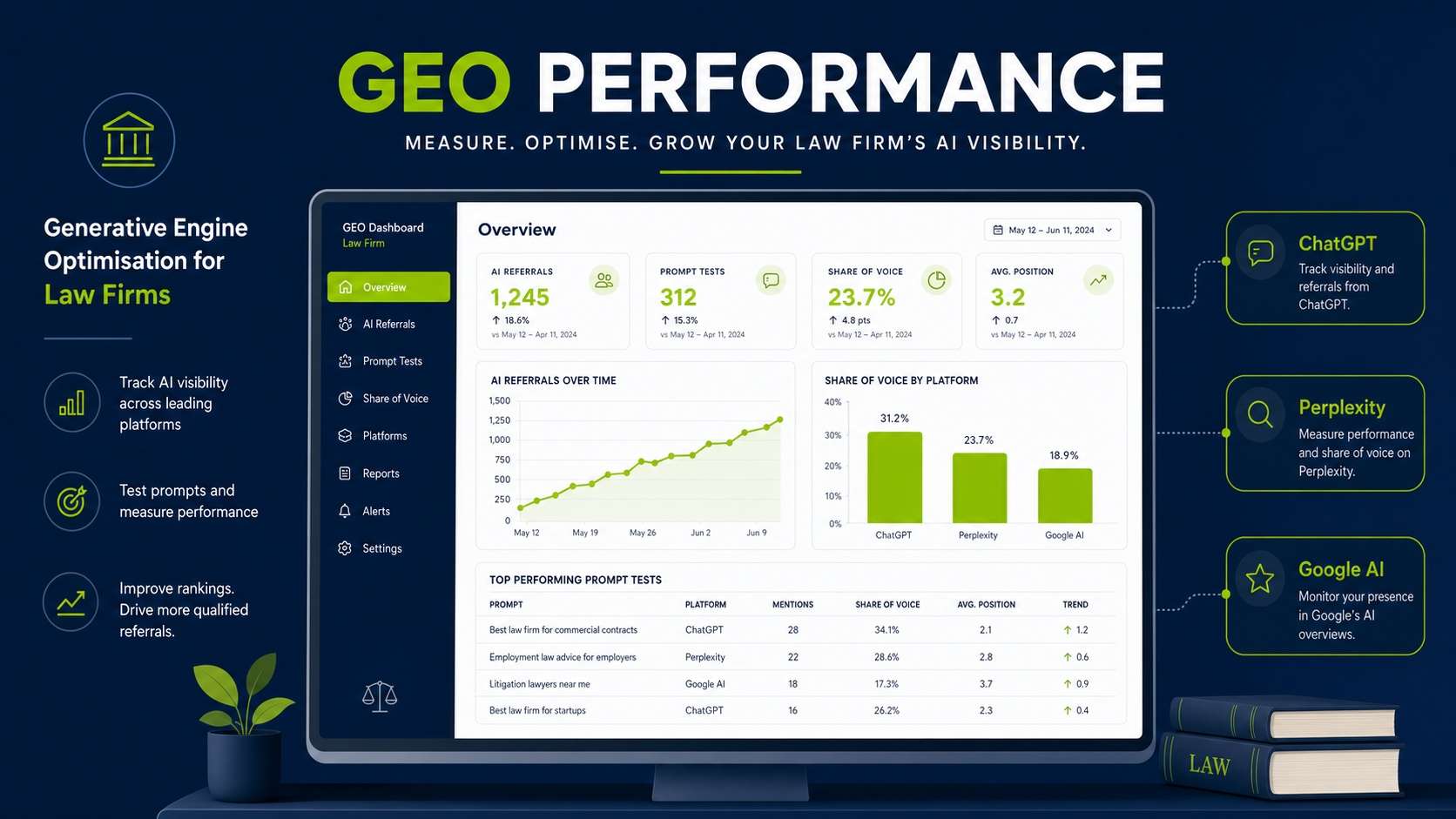
Track GEO by running regular manual prompt tests across ChatGPT, Perplexity, Gemini, and Google AI Mode; monitoring AI referral traffic in Google Analytics; and, if budget allows, using a dedicated AI monitoring tool. Connect changes in these metrics to content and authority-building actions to build an evidence base for what works.
Last reviewed – 19th June 2026
Key Points:
- This article explains how to Measure and Track GEO Performance
- Manual prompt testing across multiple AI platforms gives the most accessible baseline measurement.
- Google Analytics referral traffic from AI platforms provides a direct, traffic-based GEO metric.
- AI monitoring tools including Profound, Peec AI, and AthenaHQ track inclusion rate and share of voice.
- Competitor benchmarking reveals where AI systems cite others instead of you, and why.
- A regular measurement cadence, monthly as a minimum, is required to detect meaningful trends.
Measuring GEO performance is less straightforward than measuring traditional SEO, but a combination of manual prompt testing, referral traffic analysis, and dedicated AI monitoring tools gives a workable picture of how well your content is performing in generative AI environments. AI citation rates cannot be tracked through Google Search Console the way keyword rankings can. Establishing a consistent measurement framework early, even a simple one, allows you to connect GEO improvements to specific actions and make informed decisions about where to invest next.
Why GEO Measurement Is Different
Traditional SEO measurement relies on ranked positions, click-through rates, and organic traffic, all of which Google Search Console and Analytics track reliably. GEO performance does not map neatly onto these metrics. A brand can be cited frequently in AI-generated responses without generating measurable organic traffic, because the user may read the AI answer without ever clicking through to the cited source. Conversely, a brand generating high organic traffic may appear rarely in AI citations, if its content lacks the structural and authority signals AI systems require.
The measurement challenge is compounded by the number of platforms involved. GEO performance varies significantly across ChatGPT, Perplexity, Google AI Overviews, Gemini, Claude, and Microsoft Copilot. A source well-cited by Perplexity may be less frequently cited by ChatGPT, because the retrieval logic and training data of these platforms differ. Tracking across multiple platforms gives a more accurate picture of overall AI visibility than relying on a single data point.
Manual Prompt Testing
The most accessible GEO measurement method requires no tools beyond the AI platforms themselves. Identify fifteen to twenty queries most relevant to your business, covering the topics your target audience is most likely to ask. Run each query across ChatGPT, Perplexity, Google AI Mode, Gemini, and any other platforms your audience uses. Record whether your brand or website appears, how it is described, whether it is cited with a link, and which competitors appear instead.
Carry out this exercise at a consistent interval, fortnightly as a minimum. Use a simple spreadsheet to log results: the query, the platform, whether you appeared, whether a link was included, which competitors appeared, and any notable characteristics of the AI response. Over three to four months, patterns emerge. Queries where you consistently fail to appear often share identifiable content or authority characteristics that targeted improvements can address.
AI Referral Traffic in Google Analytics
Google Analytics 4 tracks sessions by source and medium, including sessions arriving from AI platforms. Referral traffic from chat.openai.com, perplexity.ai, and similar domains represents users who followed a citation link from an AI-generated response to your website. Monitoring these referral sources monthly gives a direct, traffic-based measure of GEO performance that connects AI visibility to a business outcome already in your analytics setup.
This metric has a natural limitation. It captures only the citations that generated clicks. Many users read an AI response that cites your brand without clicking through. Brand awareness generated by AI citation without a corresponding click is real and valuable but invisible in Analytics. Treat AI referral traffic as a floor rather than a total measure of AI visibility.
Dedicated AI Monitoring Tools
A growing range of specialist tools tracks AI citation performance at scale, measuring inclusion rates and share of voice across multiple platforms simultaneously. Profound, Peec AI, AthenaHQ, and Rank Prompt each approach this differently, but all provide some combination of inclusion rate, citation coverage, and competitive benchmarking.
These tools are most valuable for businesses where AI citation is a high-priority growth channel and manual testing across a large prompt library is impractical. The metrics they provide, particularly AI share of voice relative to named competitors, translate GEO performance into comparative data that informs strategy in the same way keyword ranking data does for SEO. Costs and platform coverage vary, so evaluating tools against your specific platform priorities before committing is worthwhile.
Key Metrics to Track
A functional GEO measurement framework tracks four primary metrics. Inclusion rate measures the percentage of target prompts where your brand appears in AI-generated responses. Citation coverage measures the percentage of appearances that include a clickable link to your domain. AI share of voice compares your inclusion rate against the same metric for your primary competitors. AI referral traffic measures sessions arriving at your website from AI platform referrals in Google Analytics.
Secondary metrics add diagnostic depth. Sentiment accuracy checks whether AI systems describe your brand correctly and favourably. Answer position records whether your brand appears first, in the middle of a list, or as a secondary mention. Tracking the specific URLs being cited reveals whether high-priority pages are earning the citations your strategy depends on.
Competitor Benchmarking
Understanding why AI systems cite competitors in preference to you is at least as useful as understanding that they do. When a manual prompt test reveals a competitor consistently cited for queries you should be winning, examine that competitor’s content. Is it more directly structured? Does it carry stronger author attribution? Does it cover the topic with greater depth or more current information? The gap analysis reveals actionable improvements more specifically than aggregate performance data alone.
Competitor benchmarking should cover the same prompt set used for self-tracking. Log which competitors appear for each query on each platform, and look for patterns. A competitor consistently cited by Perplexity but not by ChatGPT may have a strong backlink profile from sources that Perplexity’s retrieval weights heavily. A competitor cited across all platforms likely combines strong content structure, high domain authority, and a visible external reputation.
To find out more about how we can assist you in creating SEO and AI-visible content, please get in touch with me at corinne@lawtelligence.co.uk or call 01691 839661.
Corinne McKenna is the co-founder and director of Lawtelligence, a specialist legal marketing agency serving UK solicitors and barristers. With an LLB degree from the University of Canterbury and over 25 years’ experience in legal services sales and marketing, Corinne brings substantive legal knowledge to marketing strategy and brand development. Her background includes roles at LexisNexis in the UK and New Zealand, where she managed key legal accounts and delivered training to law firms. Corinne has authored widely on legal marketing topics for publications including Today’s Conveyancer and Solicitors Journal, with particular expertise in E-E-A-T principles, AI-optimised content, and SEO strategy for legal services.
Frequently Asked Questions
How many prompts should I test manually?
Fifteen to twenty-five prompts covering your primary topic clusters is a practical range for most businesses. Include a mix of informational queries (how does X work?), comparison queries (X versus Y for Z situation), and high-intent queries (find a solicitor for Y in Z location). The goal is a prompt set representative of the queries your target audience actually uses. Quality and representativeness matter more than volume.
Which AI platforms should I test on?
At a minimum, test on ChatGPT, Perplexity, and Google AI Overviews. These three platforms account for the largest share of AI search queries for most business categories. If your audience includes a significant share of Microsoft 365 users, add Copilot. Prioritise the platforms your specific audience uses most frequently rather than attempting to track every available AI system.
How do I track GEO without paying for specialist tools?
Manual prompt testing and Google Analytics referral traffic monitoring provide a functional GEO measurement framework at no cost. Set up a simple spreadsheet to log manual test results consistently, and monitor AI referral traffic as a separate segment in your Analytics dashboard. These two approaches together give you inclusion rate trends and a click-through measure that are sufficient for most businesses in the early stages of GEO investment.
What counts as a GEO win?
A GEO win is any AI-generated response that mentions or cites your brand accurately in a positive context relevant to your services. A link citation to your website is a strong win. A brand mention without a link is still a meaningful win because it builds brand familiarity with users who may not have encountered you through traditional search. A positive description of your services in an AI answer that also includes competitor names is a partial win, worth tracking separately to understand your competitive position.
Should I report GEO metrics to stakeholders?
Yes, and framing matters. GEO metrics are less familiar to most stakeholders than traditional SEO metrics. Presenting AI inclusion rate alongside organic traffic trends, and showing how AI referral traffic contributes to total enquiry volume, connects GEO performance to business outcomes stakeholders already track. A quarterly GEO report that shows inclusion rate trends, top cited pages, and competitor share of voice provides the evidence base needed to sustain GEO investment over the medium term.